
Daniel Etter could have rested on his laurels after this award. In 2016, the German photojournalist and his colleagues received the prestigious American Pulitzer Prize in the „Breaking News Photography“ category. His photograph of an Iraqi father breaking down in tears on the beach of the Greek island of Kos after being rescued became world-famous.
But Etter didn't rest on his laurels; he wanted to find out how the distressed man and his family fared on their onward journey through Europe. And he wanted to restore truth to the image, which had been instrumentalized and partly deliberately misinterpreted on the internet, with his research. For the reportage „A Short Dream,“ published in the magazine of the Süddeutsche Zeitung, Etter was awarded the Hansel-Mieth Prize 2017 on Wednesday evening.
„Poignant and honest,“ said Fellbach's mayor, Gabriele Zull, to the well over two hundred guests at the celebration in Fellbach's town hall, as the reporter described the family's journey. They had reached the dream of their lives – Germany – but were torn between leaving and staying, ultimately returning because the grandmother in Iraq was dying. It was a depiction not in black and white, but nuanced and in shades of gray, a story that „raises more questions than it answers.“.
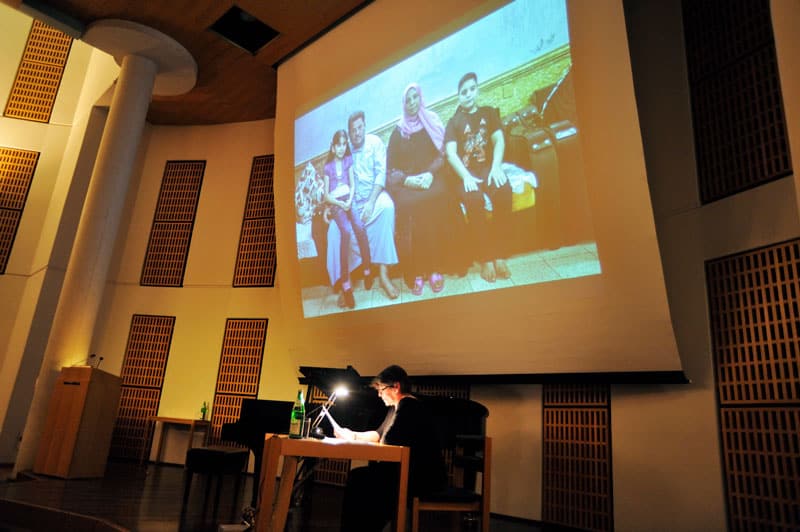
The photographer also questions himself and his work. Etter's reportage is not limited to recounting family history. He also addresses the impact of his famous photograph on the family, even to the hesitant question: „Do they still want to see me?“ As he grew closer to his subjects, so did his doubts about whether he was engaging in voyeurism, „turning personal destinies into journalistic stories.“.
A story full of barbs, inviting reflection on the role of reporters. How he sees his role today, Etter was asked in the subsequent discussion. He doesn't think the family's path would have been different had he not taken the photo. „It wasn't just a personal moment, but a geopolitical one.“ That the photo later makes the family man „tired“ because it evokes bad memories, because it appears on the internet in completely wrong contexts, and because media fame has its downsides – he has to live with the dilemma, said Etter.
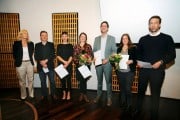
This also demonstrates how much responsibility and tact is required Multimedia Report by Christina Schmidt and Maria Feck about the high suicide rate among young Greenlanders, which won the Hansel-Mieth-Prize Digital 2017.
Journalism, as a realization of the evening, needs this sense of responsibility. If journalism takes its tasks seriously, looks closely, questions, and shows nuances and contradictions, there can be no talk of voyeurism. „And that is precisely what the award winners have achieved,„ emphasized Uschi Entenmann from the agency Zeitenspiegel in her laudatory speech. “They have brought people closer to us."