
Photo: Eric Vazzoler
From September 4th to 9th, the Summit for Peacemakers from all over the world took place for the first time in Paretz. Almost unnoticed by the public, the participants have been working for years for what currently seems a distant dream: a peaceful world.
Photo: Eric Vazzoler
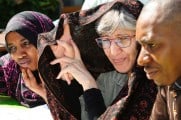
“Politicians from all walks of life demand that we ”combat the root causes of flight." But who is supposed to combat them? And above all, how? While the parties are still arguing about the answers, there are many people who have long since started working – sometimes with great success. For example, Imam Ashafa and Pastor James Wuye, who mediate between feuding Christian and Muslim communities in Nigeria; Mossarat Quadeem from Pakistan, who pulls young people out of the grip of Islamists and brings them back to civilian life; Assad Chaftari, who transformed himself from a secret service chief into an educator in Lebanese schools. There, he convinces young people that conflicts cannot be resolved through violence.
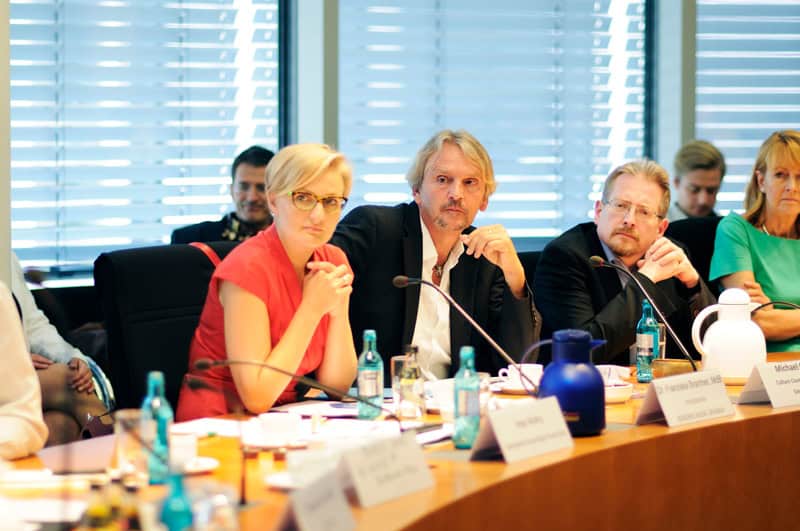
You are among the 30 participants of the first „Global Peacebuilder Summit“ for peacebuilders from all over the world. For a week, they gathered at a conference center of the Breuninger Foundation in Paretz, a village of 400 inhabitants in Brandenburg that couldn't be more peaceful, and exchanged ideas on how to rebuild their war-torn countries. Always with the question: „What strengthens civil society?“ They were both participants and speakers; politicians or representatives of the international community were nowhere to be found at this conference. "They know best what their country needs," says Michael Gleich, moderator, journalist, and author, who founded the summit with his Culture Counts Foundation.
He has reported on numerous such peacemakers in crisis regions for the „Peace Counts“ project and works closely with experts and institutions in the field of civilian conflict prevention. These include the Berghof Foundation, the zivik support program from the Institute for Foreign Relations (IFA), Ashoka, and Peace Direct. Participants were selected and invited from the shared pool of contacts. „It has always been my dream to bring these courageous people together in one place.“

With the peace summit, he wanted to give them a space where they could get to know each other and exchange ideas. But also the opportunity to pause and reflect. „The conflicts are not only external, but also within me,“ describes Fatuma Adan, a Muslim woman from Kenya. The 38-year-old studied lawyer brings hostile village communities in the hinterland together through football tournaments, and her project has already received international recognition. However, working in conflict regions is exhausting over the years. That's why the summit also turned inwards with the question: What strengthens us?
„I miss interacting with like-minded people in my daily life,” says Edgar Khachatryan from Armenia, who is involved in theater and dialogue projects. “I need to feel like I’m not alone.“ He shares the difficulties of his work with others: Who guarantees his safety? How can he motivate staff? How can he finance his projects? There is always someone who has already found a solution. „The peacebuilders are the experts and can advise each other,“ says Michael Gleich. „They do important work for peace processes but are hardly recognized.“ That’s why he often calls them „unsung heroes.“.

After three intensive days in the idyllic village, the participants drove towards the capital. „In Berlin, they were able to put forward their specific political demands,“ says Michael Gleich, explaining the second part of the summit. On Thursday at the Bundestag's Subcommittee on Civilian Crisis Prevention, on Friday at the Federal Foreign Office, which is helping to fund the conference and assisted with visa applications. There, the participants met politicians from the conservative to the left and talked about their difficulties and the solutions they had found. They had plenty of demands, first and foremost: adapt your policies to our realities, listen to us, ask about our needs. They also emphasized a central conflict: peace work takes time, long-term thinking is its basis, but sponsors demand results after just a few months. Finally, they asked for support for their newly founded coalition, which is to become a global peace movement.
They want to meet again next year. „The summit is now in their hands,“ says Michael Gleich, who has agreed to take on the organization again with the Culture Counts Foundation. The chances are good, after all Rüdiger König, Head of the Department for Crisis Prevention at the Federal Foreign Office, announced his support in the closing speech. Until then, the participants have already networked themselves: For example, one participant wants to learn from Fatuma Adan's soccer project and set up one in Somalia too. Fatuma Adan, for her part, wants to appear more confident in the media and is receiving some lessons in interviewing from a radio producer from Mali. They want to put the vision they formulated during the week into practice straight away: To work together at a local level for global peace. „Give us a voice,“ said Fatuma Adan to the subcommittee of the Bundestag. „Then at some point we will become so loud that those out there will have no choice but to listen to us.“