
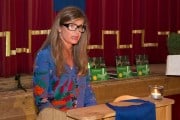
Sabine Gruber | Photo: Frank Brunner
On June 1st, the Zeitenspiegel Reportagen awarded the Gabriel Grüner scholarships. Therefore, we are pleased to publish the laudation given this year by the writer Sabine Gruber:
Distinguished award winners, dear Beatrix, dear family members and friends of Gabriel, dear attendees!
It has been almost half a lifetime since I spent time with my childhood friend Gabriel Grüner here in Mals in the Vinschgau. Even today, 19 years after Gabriel's early death in June 1999, I still find it difficult to speak publicly about him and his work. Memories are sometimes very private and can differ from the memories of other contemporaries.
Gabriel and I met through literature. He had started as a writer, having already written poems and short stories in business school. But what connected us even more were the South Tyrolean circumstances we came from, the shared search for an escape route into the wide, wide world, an escape route through language.
How does someone become who they are? We've often asked ourselves this question. To understand how or why someone became who they are, or who they were, it can be helpful to understand where they come from, what time period, and what country.
Reading and writing had been our initial capital. That a young man like Gabriel had decided to study Germanistik was not a given even back then. Then as now, it was predominantly a field of study chosen by women, one that did not promise a particularly high income. Money was not important to us/to Gabriel; status symbols like a fancy car or real estate didn't interest him; he didn't strive for a bourgeois, secure life. Anyone who knew his apartments knows that they retained the charm of a student dorm room until the very end. That probably would have changed after the birth of his son Jakob.
We were the post-68 generation, sought out the open-minded professors at university and avoided the old Nazis who were still lecturing to a bunch of diehards. We were politicized, social and critical, got involved in the left-wing South Tyrolean Students„ Union, wrote for their magazine “Skolast„; we helped Turkish immigrant children with their homework and went to school consultations because their mothers were illiterate and hardly spoke any German. And we demonstrated against the NATO nuclear weapons depot in Natz-Schabs near Brixen, against the stationing of short-range missiles during the Cold War in Italy, our “homeland„. We voted for Alexander Langer's New Left, sympathized with Berlinguer's PCI and polemicized against the policy of ethnic separation, against the right wing of the South Tyrolean People's Party, which had campaigned in 1979 with the slogan “The more clearly we separate, the better we understand each other".
We read Der Spiegel, the pop culture magazine Spex, the satire magazine Titanic, books by Uwe Johnson, Nicolas Born, Rolf Dieter Brinkmann, Christa Wolf, and Wolfgang Koeppen. The list could go on.
So we were the post-„68ers. For us, what the German literary scholar Helmut Lethen, who lives in Vienna, recently said about the “68ers still held true: "The '68 movement, as a breakthrough, was a sign of longing for the world. That also meant solidarity with the struggles of peoples in foreign countries. The melody of this longing was pop culture." (Falter 18/18 p. 35) From Gabriel's room, you could hear the Rolling Stones, Lou Reed, Eric Clapton, Bob Dylan, Peter Gabriel, Tom Waits, Sting, but he also put tapes with Billy Bragg's protest songs and Wolf Biermann's political songs into the recorder.
After our studies, neither of us wanted to return to South Tyrol, following Biermann's motto, „Only those who change remain true to themselves.“ „Returning“ would have meant working as a teacher in South Tyrol or writing for one of the regional newspapers; there were hardly any independent media at the time, and the alternative publishing landscape was just beginning to be established. This did not mean that we didn't care about our home country. Gabriel loved South Tyrol, loved his family, his friends, and valued those who tried to change things on the ground. When we met later for Christmas in Meran or Bozen, when he visited me in Venice or I visited him in Hamburg, South Tyrolean political and family matters were always a topic of conversation.
So how does one become who they are? How did Gabriel become a reporter at Stern?
When we met the cybernetician Valentin von Breitenberg, the editor of an anthology, in Merano in 1988, and Gabriel's story was not well received in Breitenberg's critique, Gabriel remarked, as the door closed behind us, laconically: „You will become a writer, and I will become a journalist.“ We were 25 then. He refused to revise the story, withdrew his text, even though he had already received recognition, even a literary prize, for his literary writing.
Four years earlier, his father, forester Volkmar Grüner, had died of throat cancer at just under 43 years old in March 1984. This turning point had shaped Gabriel; as the eldest of four siblings, he felt pushed into the role of a surrogate father from then on.
Out of political conviction, he refused Italian military service, finding ways to circumvent it through a sham employment in Berlin. In the mid/late eighties, he increasingly wrote for "Der Skolast" about internal restructuring in the South Tyrolean student union, about Diederich Diederichsen's Sexbeat book, about 25 years of the Rolling Stones, about books by Rainald Goetz, Rolf Dieter Brinkmann, Norbert C. Kaser, Thomas Bernhard, and Michael Köhlmeier, and interviewed Wolf Biermann and the South Tyrolean politician Alexander Langer.
When Gabriel applied to the Henri Nannen School in Hamburg, he dreamed of a position in the features section of a major German newspaper. He was still far from social reporting or covering war zones. Nevertheless, even then, he was someone who rejected superficiality and hasty ideological partisanship. He had smiled at the „revolutionary“ students returning from Nicaragua for their blind love of the Sandinistas, just as he had at those fellow students who had worn Keffiyehs without engaging with antisemitism in general and in Tyrol in particular, without having taken a closer look at the Shoah and figures like the South Tyrolean deserter Franz Thaler, who had been in Dachau and the Hersburg subcamp of Flossenbürg.
I already appreciated Gabriel for his linguistic accuracy, his historical knowledge, and his ability to differentiate politically during my studies, skills he had already acquired during his studies in Innsbruck, but which were also the result of his socialization.
He often compared his father's family history to the fate of the Buddenbrooks. Thomas Mann's novel depicts the decline of a well-to-do Hanseatic merchant family. The Grüners, too, had once been a respected, wealthy apothecary family in Mals, of whom only the old glass bottles and pipettes that Gabriel had found in the attic of the old apothecary house on General Ignaz Verdross Street ultimately remained. His mother Erika came from the Ruhr area, from a social democratic working-class family. When asked about it, Gabriel often quoted the first lines of the Grönemeyer song dedicated to his mother's hometown, „Deep in the West, where the sun gets dusty/it's better/much better than you think (...) Bochum, I come from you/Bochum/I'm attached to you...‘
The not-so-easy life with a father who was a forester and was repeatedly transferred to different regions of South Tyrol, which meant the entire family had to move from Steinhaus in the Ahrntal valley to Kiens in the Pustertal valley, and further on to Mals in the Vinschgau valley, and a mother who felt like a stranger in South Tyrol for a long time, left their mark.
In 1983, when I first visited Gabriel's family in Kiens, he tried to prevent me from entering the kitchen at night, after we had attended an outdoor concert in Bruneck, because he didn't want me to meet his father, who had had one too many drinks that evening.
I liked Volkmar; he had a similar sense of humor to Gabriel's, ironic, dry – he never laughed at the expense of weaker people.
Starting from these life circumstances, it's not surprising that Gabriel, as a half-orphan, couldn't turn down an offer like the one from Stern after graduating from journalism school in Hamburg. He hadn't decided to become a war correspondent or a reporter from crisis zones; he had drifted into this profession. After his internship at the weekly newspaper DIE ZEIT, Gabriel had still hoped to get a job in their culture department. He wasn't a "Hamburger," he said at the time; he lacked the necessary connections.
1994, as Gabriel had already reported from many crisis zones, I asked him for information for a fictional character named Denzel, who is shot by snipers in Sarajevo. I was interested in the reactions of his colleagues in the newsroom. At that time, Stern journalist Jochen Piest—he was exactly six months younger than Gabriel—had been fatally hit by a Chechen fighter, who had fired from a hijacked locomotive at a Russian demining team, not far from Grozny, shortly before his 31st birthday.
Gabriel answered my questions via fax, unfortunately, the answers had already been unreadable a few years ago. However, they have been incorporated into my debut novel Aushäusige in a slightly modified form; enclosed is a quote from the journalist Anton's perspective:
„You know, none of us will be sent to war zones unless we volunteer. All that was missing was for him (the editor-in-chief, S.G.) to add: “Only prudent and experienced people. Everyone in the house knows that it was Denzel's second trip abroad, that he had been asked around and pressured for so long in the meeting until he said yes. (...) Oh Denzel(...) Why didn't you put on that used American steel helmet? Why was it on the back seat? (...) They do so many stupid things because they want to be something special, little heroes among heroes, in close contact with death. (...) I myself had been on a Bundeswehr Trans-All from Zagreb to Sarajevo, back then with Christopher, an American war photographer with experience of Lebanon. At the airport, I asked a Norwegian officer whether it was possible to enter the city: "Sure, if you want to kill yourself. In front of the Holiday Inn Hotel we had to watch an American camerawoman get her jaw shot out. We left immediately, two double whiskies in our blood. In the five-kilometer-long sniper's alley between the city and the airport, I swore to myself that in future I would only write about Handke's walks." (Aushäusige, excerpts from pages 106-108 Munich: dtv 1999)
The novel was published three years before Gabriel's death. The topic it addressed, war correspondents/war reporting – writing as a banishment of fear – was also due to my ongoing concern for Gabriel. We wrote letters to each other until his death, and I learned many details about his professional life. On September 5, 1995, he wrote to me from the small Irish town of Clifden: „Before leaving for Ireland, I had been to Bosnia twice in a row. You know, one time I was robbed. The story of the second trip still hasn't been printed... (The photos are beautiful, but too quiet. You have to listen to arguments like that from the arrogant assholes in the editorial office. What do they know about how exhausting, dangerous, and draining a trip to Bosnia is? They just sit in their fancy BMWs or Mercedes and nicely drive off to their vacation villa in Sylt every weekend...).“
I don't have any sociological studies on the backgrounds of journalists working in war zones; however, my research for the novel Daldossi, or The Life of the Moment, which is about war photographers, has shown that many, very many reporters come from difficult and humble backgrounds. They often find themselves in crisis areas by chance rather than by design, and then they venture deeper and deeper because, overwhelmed by the suffering and impressions, they want to do something for the victims.
Above all, the fate of the children had touched Gabriel deeply: „We must work to spare the children of war the return of hatred, destruction, and murder,“ he wrote in 1996 in the foreword to the catalog "Children of War – Pictures from Bosnia." It was no coincidence that one of his first articles for Stern magazine was about the disastrous living conditions of the Bucharest train station children. He, who loved to sleep in, had as a student already opened the door to our shared student apartment at 7 a.m. on Sundays for four immigrant children from Anatolia because he couldn't bear to keep them waiting longer in the cold.
When Slavenka Drakuli?„s book “Nobody Was There: War Crimes in the Balkans„ was published, Gabriel had already been dead for four years. A socialist society (and the subsequent nationalist one) knows no individual responsibility – according to the Croatian writer. Before the fall of the Srebrenica enclave, the Serbian propaganda machine had demonized Croats, Muslims, and Albanians as enemies for almost ten years. “The fall of Srebrenica and the subsequent mass murders were only possible through long psychological preparation." (p. 93)
No, I will not provide late justifications for the crimes in the Balkans now. Drakuli? poses the fundamental question of why a neighbor suddenly becomes an enemy – Gabriel and I often discussed this question. Long before the war in the Balkans, shaped by the ethnic segregation policies of the seventies and eighties in South Tyrol, we talked about the effects of ideologically manipulated memory culture, about national stereotypes, about solidified notions that German-speaking South Tyroleans have about Italians or vice versa Italians about German-speakers. We polemicized and wrote against this. Peaceful coexistence in South Tyrol is the result of a hard-won autonomy that regulates the coexistence of ethnicities. But it is also the result of many articles and interviews in which dialogue was sought and for more self-responsibility was promoted.
Hypotheses are meaningless after the death of a loved one, yet I've often wondered what would have become of Gabriel if he had been allowed to write for a major German feature section. He probably would still be alive. How would someone like him have survived in that intellectual circle, surrounded by all those vain critics?
At the latest during a hike in his old homeland, which might have led him past the Saxalbhof at an altitude of 1363 meters, he would have started talking to Fortunat and Katrin Gurschler, just like the two young prize winners Greta Maurer and Lea Schrentewein from the Walther von der Vogelweide high school in Bolzano, and he would have asked Katrin what it's like to be a German immigrant on the remote South Tyrolean mountain farm, or he would have asked what grows in the garden. He certainly would have asked little Anton about his toy cars.
How does one become who they are/who they were? Aren't they already what they are becoming? Aren't they already what they had become? Equipped with a perspective from below, trained on countless literary texts, but also on the difficulties of a fatherless family, on the shame of financial hardship, someone who includes solidarity with the exploited, the marginalized, and the disadvantaged by fate. Someone who empathizes and therefore doesn't stop fighting? Someone who could only show his love for his son Jakob, whom he tragically never got to know, through his affection for all the many children he wished/hoped to spare further horrors through his writing?
I don't know the biographies of the two journalists receiving the Gabriel Grüner Scholarship, I have no idea where their taking the side of the weak comes from, but I do know that Marius Münstermann and Christian Werner, for a previous report on Indian children who toil in mines so that we can have shiny cars and shiny lipsticks in our comfort zone, are continuing the path taken by Gabriel.
Before me lies an undated letter with the Star logo: „Dearest Schiwine,“ Gabriel wrote, mispronouncing my name, „here is my Afghanistan report. You may sob with emotion twice & then wish me all the best in my love life. Your Gabriel“
He knew how difficult it was to shake people up with reports about wars and incompetent politicians. A Sisyphean task. For many, their worldview or their own garden is enough of a outlook; it's sufficient for them to „burst into tears twice“ and then move on with their day.
The revolution in the media world is having a devastating impact on independent, reputable reporting. In social networks, in-depth discussion is increasingly becoming meta-communication. Comments about criticism dominate, while the actual articles are often not read at all or only skimmed.
„In Germany,“ says media scientist Bernhard Pörksen in an interview, „we still have good newspapers, interesting, diverse media. That doesn't mean they don't make mistakes, cross boundaries, and deserve criticism. But they are being battered by a fatal interplay of refinancing crisis and crisis of trust. That's the unsolved million-euro question. How can quality be refinanced? You can make a lot of money with dirt. But not with quality, which is expensive to produce.“ (Falter 19/18, p. 28)
However, for excellent young journalists and photographers like Marius Münstermann and Christian Werner to deliver a high-quality reportage on the fight for prized tuna off the West African coast, it requires not only financial resources but also the courage and conviction that it is worthwhile to fight alongside marine conservationists like the radical environmental activists Sea Shepherd for a better, more just world.
Only through enlightenment, through empathy with the dispossessed, the violently oppressed, in the fight against exploiters, pirates, and human traffickers, do we gain a different, critical political consciousness, and become what most of us are not yet: engaged readers with a will for change.
I heartily congratulate you, Marius Münstermann and Christian Werner, on the 2018 Gabriel Grüner Scholarship and wish you all the best with your research off the coast of Gabon and all the best in your – as Gabriel would say – „matters of the heart.“ Take care of yourselves!